Posture. It’s a Habit.
The body possesses an incredible innate ability to hold onto habitual patterns. From the moment we learn to walk, our bodies begin to develop muscle memory that allows us to repeat the same movement without conscious thought. This remarkable capability extends to all areas of our daily lives. Whether it's the way we sit, the way we type on a keyboard, or even the way we hold our breath in moments of stress, our bodies form patterns that become deeply ingrained over time. These patterns serve as a kind of default setting for our physical behaviors, allowing us to perform tasks efficiently and with minimal effort. The body's ability to hold onto these habitual patterns is a testament to its extraordinary adaptability and the power of repetition in shaping our physiological responses. Understanding this innate ability can enable us to consciously reshape and reprogram our bodies towards healthier and more beneficial habits.
In this article, I will give insight into my approach to bodywork, when a client says “ I think my shoulders are rounding” or any of its associations, like “I work all day at a computer” or “this dull achey pain between or around my shoulders.” I’ll note relevant shoulder anatomy, two chronic positions that exacerbate rounding & provide movements to promote different postural habits.
First, some shoulder anatomy. Today, we will look at two joints, the glenohumeral joint, where your upper arm bone, the humerus, moves within the glenoid fossa of the scapula, & the scapulothoracic joint, where the scapula interacts with the clavicle & ribs. Understanding shoulder disfunction starts with an understanding of which joint is being effected.
The Glenohumeral Joint is a highly mobile, ball-and-socket joint. For purposes this article, I’ll be denoting this joint & its actions as part of the arm. Its *actions include flexion & extension, internal / medial rotation & external / lateral rotation, abduction & adduction, horizontal abduction & horizontal adduction. Combining all of these actions allows the joint to circumduct, creating a cone shaped movement, like the backstroke.
The Scapulothoracic Joint is not a true *synovial joint. Its only joint articulation is between the acromion & the lateral aspect of the clavicle [the AC joint]. However, the scapula must glide over the ribs to function properly. Its actions include elevation & depression, protraction / abduction & retraction / adduction, upward & downward rotation. Upward rotation occur only after the arm passes 90 degrees of abduction; the GH joint abducts to 90 degrees, then the scapula upwardly rotates. The scapula downwardly rotates, as the arm is lowered, until 90 degrees. Then the GH joint adducts.
For the purpose of this article, I would also like to note that the scapula can also “tip anteriorly.” Weakness in the serratus anterior and tension in the pectoralis minor can raise the medial boarder & inferior angle of the scapula off the ribcage i.e. scapular winging
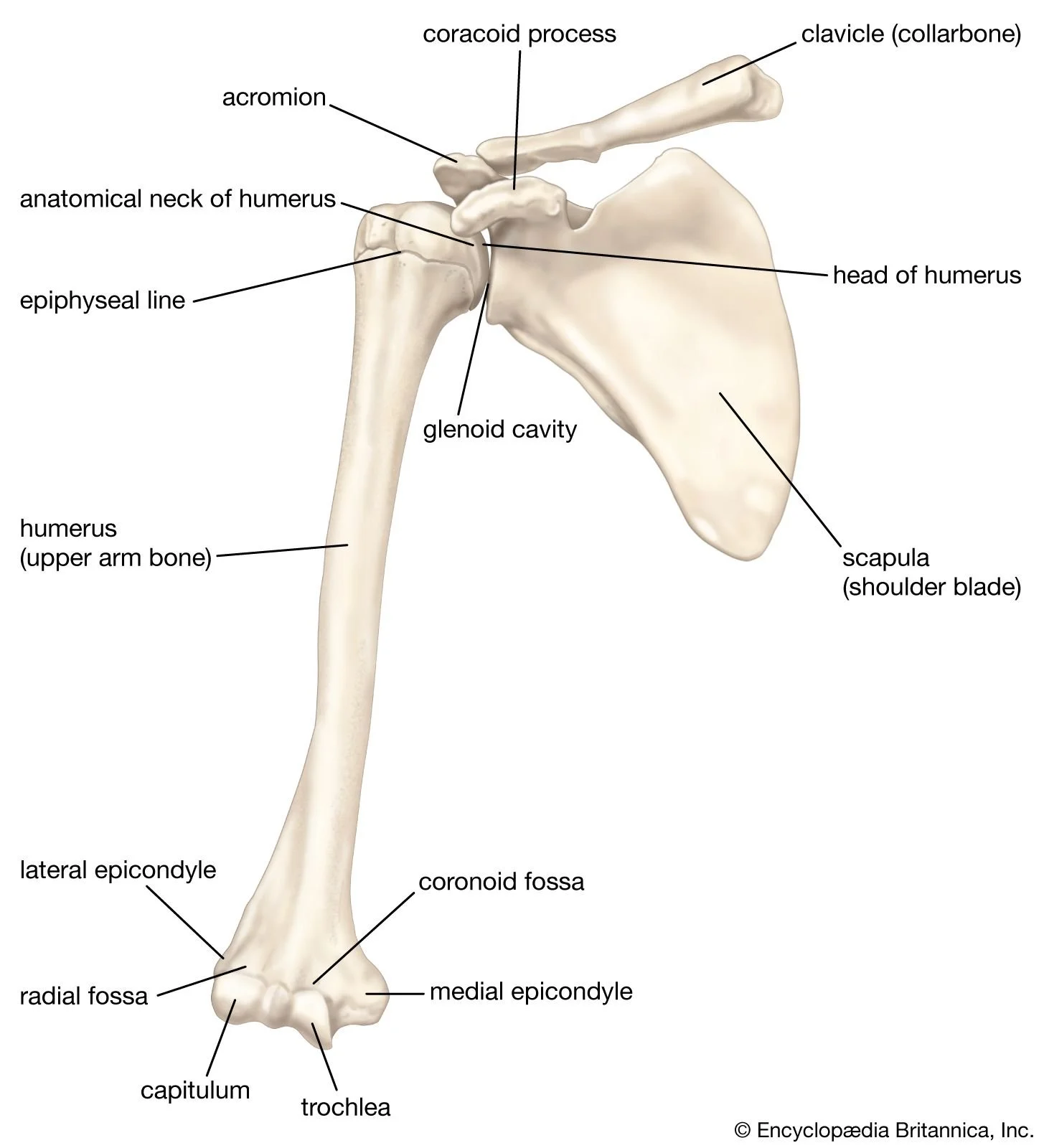
Note the shallow, glenoid fossa, coracoid process, and acromion. Imagine the humerus abducting. At about 90 degrees, the head of the humorous “contacts” the acromion. After contact, the scapula and the humerus upwardly rotate as a unit. Pectoralis minor originates at the coracoid can be palpated from the anteriorly, with scapular depression.
Stand in front of the mirror. Look at your shoulders. What do you see? Do you see more of one ear than another (rotation), a decreased space between one ear and the shoulder (lateral flexion)? These are neck actions but muscles of the shoulder also move the neck, go figure. Now, look at the arm & shoulder. Are there lots of wrinkles in your shirt in front of the armpit? Do you see all of your knuckles or does the thumb face forwards? These are some things I look at when doing posture assessments. Just because someone “appears” one way does not mean they have pain or limited movement but it may be an indicator.
Common Positions that exacerbate rounding shoulders:
All movements are observations & suggestions from my practice. While many of these positions movements may help some people, always move within your own range of comfort, & seek a professional for advanced care.
-
Chronic sitting, in suboptimal positions, leads to MANY hip, back, shoulder, and neck dysfunctions. If you have not mindfully experienced your position recently, “do I feel pain or tension sitting here?” NOW is the perfect time to pay attention.
Starting from the feet, top of the foot to the ground, ankles crossed, knees bent, tucked under the chair. This position also causes chronic, posterior leg contractions / cramps; think sole of the foot, calf, and hamstring.At the hip, the knees splay out to the side, externally rotating the femur. Chronic external rotation may contract the glutes & piriformis, making it difficult to lift the knee or rotate the hip, producing posterior / lateral hip pain, pain around the sacrum & sacroiliac (SI) joint, & lead to piriformis syndrome or sciatica.
Flexing at the lumbar spine feels like slouching or lazy sitting. Due to the concave curve in this area, flexion decreases the support vertebrae provide each other. Extra force and suboptimal positions wear the cartilage irregularly. Over time, dysfunctions like herniations, bulging discs, and arthritis will appear.
In the thoracic / scapular region, flexing the spine feels like collapsing, heaviness, sadness, shallow breathing. In addition to flexing the spine, the scapula may move anteriorly, producing tight, stretching sensations, and pain between the shoulder blades. Also in this area, the humerus can medially rotate from tension in the pecs, subscapularis, latissimus dorsi. Lots of muscles to help us operate in front of our body; its important to balance their *antagonist pairs to keep the shoulders back & down. This area is hyper mobile, with many joints, compared to other regions. Work here may require significant time and consist of breath training, GH & ST mobilization, in addition to spine work.
At the top the spine, the head moves anteriorly, placing the ear in front of the shoulder. For every inch the head moves past the shoulder, ~8lb of pressure is added to the spine & spinal extensors. The anterior neck muscles also contract, leaving tightness in the upper chest & throat; pulling the head back, looking up, and pressing the chin towards the ceiling may provide a significant stretch.
-
Consider specifically the scapula & arm.
Starting at the hand, the palms rotate down to the floor. This by itself is not an indicator of “shoulder rounding” as the radialulnar joint (lower arm) is moving, not the GH (upper arm). You can experience this with a bent elbow, rotating the palm, like opening a door.
Next, the humerus medially rotates, & elbows point out. Try this laying down. Abduct the GH to 90 degrees & flex the elbow from anatomical position, to 90 degrees; the fingers should be pointing to the ceiling, with the palm to the face. Now rotate the arm, like a karate chop; pay special attention to the sensation of your scapula against the ground. Try repeating this with the elbow close to the body, moving laterally, like serving a plate.
I’d guess more than 80% of people working with me for the first time lay on the table, face up, palms down, elbows out, & complain of pain between their scapula. After repositioning one shoulder, by the time I move to reposition the opposite shoulder, they often return to a medially rotated position on the first side. Talk about an engrained pattern!
And how to adjust them:
All movements are suggestions, not prescriptions. While these positions may help some people, always move within your own range of comfort, & seek a professional for advanced care.
-
Quick tip: If you buy the best lumbar support but lean forward, not feeling it, it is doing nothing.
Feet flat on the floor, knees angled below hips. If your feet do not touch the ground, raise the ground with props. Try not to cross the ankles or let the knees fall to the side.
Lift the shoulders up, gently squeeze them back, & let them settle down on your back. Slightly lift the chest and tuck the chin.
Bring your elbows slightly closer to the side, elbows below the shoulder.
If this position feels uncomfortable, I have two options for support, one physical, for long durations of sitting, the other is a mental support, to train the position, for shorter durations. If this feels like a lot of work, sitting is a lot of work. That’s why slouching is so common & why so many people suffer from lumbar pain.
Physical Support - First, find the sitting position outlined above. You will build your support around this position. Find a slightly firm pillow or rolled up towel / blanket. Place it behind you, so you feel the support around the lumber area; Support as much of your back as necessary. Now relax back onto the support. Relaxing here, it should feel comfortable and sustainable, without slouching, & the chest up.
Mental Support - First find the position outlined above. Place a slightly firm pillow / bolster just below or around the scapula, wherever feels comfortable; if you lean back onto the support, it should collapse; leaning forward, it should fall. This is to train your brain to maintain the position, with minimal support. Try this for a while, then take it away. Is it easy to maintain the position without physical contact? Over time, you may need this support less and less.
-
Try these movements only on one side, at first. Place the opposite handover the front of the shoulder, just in front of the armpit. Flexion, medial rotation, & horizontal adduction will produce contracting, shortening, “bunching” sensations. External Rotation & abduction will produce stretching, lengthening, or expanding sensations.
Bend the knees, feet flat on the ground. Knees can support each other.
Roll the palms face up & retract your scapula, bring them onto your back. Think “back and down.” Gently lift in the chest & tuck the chin. A small, rolled up towel may be a comfortable support for the back of the neck
Repeat, with both sides. If you are comfortable, extend the legs. Avoid contracting sensations in the back. If you feel this, keep the knees bent.
Stretches & Movements:
All movements are suggestions, not prescriptions. While these movements may help some people, always move within your own range of comfort, & seek a professional for advanced care.
-
Can be done Seated or Standing. Note: Consider the air dense, as if you have to push & pull your way through it. Move Deliberately. Move Slowly.
Seated, feet flat on the ground. Breathe in, the arms move out and up, overhead, looking up.
Exhale, palms press together, down in front of the chest.
Breathing in, palms press out in front of you, straightening the arms, & rounding the back.
Exhale, squeeze the shoulder blades together, bending the elbows, pulling back and down, looking up.
Breathing in, arms press & squeeze forward, like hugging a tree, rounding the back.
Continue pressing and pulling with the arms, flexing & extending the spine. Don’t forget to move your chin, looking up, looking down.
-
Can be done Knealing, Seated at a desk, or Standing at a counter.
Extend the arms forward, palms down. Bend the knees & press the hips back and down. You may need to adjust how far you are from your support. *If you feel pinching at the shoulder, reach forward less. Press the hips back more.
Breathing In - press down through the palms, rounding the upper back.
Feel for expanding sensations between the scapula
Breathing Out - relax the arms & let the chest settle down; think cow pose
Repeat as needed.
Consider holding each of these positions for a few breaths, to feel the subtle movements of each position.
-
More advanced version of child’s pose.
Start in a table-top position. Leave the hips lifted and walk the hands forwards, the chest getting closer to the ground.
Breathing In - press the hands down rounding the upper back.
Breathing Out - relax the arms & let the chest settle down.
Repeat as needed.
Add blocks under the hands to increase the stretch.
Going deeper - move bolsters to support the upper arm, just above the elbow. Adjusting the angle of the elbow changes the stretch. Breathing In - press down with the elbow & round the back.
-
Lay face-up, supported from the head to the sacrum.
Bending the knees, feet flat on the ground is more gentle than straight legs.
Try adding or removing areas of support, noting around the neck and sacrum.
Roll the shoulders back & down, letting the palms open to the ceiling. Start with the hands by the hips, slowly abducting until you feel a stretch in the chest. Bending the elbows, back of the hand still on the ground, will produce sensations closer to the chest.
Breathe, for as long as you like.
Consider gathering a blanket for warmth. Add gentle weight to the abdomen, if you wish to practice diaphragmatic breathing. Focus on pressing the abdomen to the ceiling, breathing in.
Let me know if this helps you.
*Actions - all joint actions in this article start from the anatomical position, palms forward, and the body in an erect position.
*Synovial Joint - a type of joint, containing a cavity, filled with synovial fluid, with a likeness to honey. When these joint do not move, the fluid hardens; when the joint moves, the fluid softens. This is why even minimal warmups will increase athletic performance and why you may feel less stiff after getting out of bed. Motion is the lotion! It really is.
*Agonist / Antagonist Pair - Agonist and antagonist muscle pairs work together to create movement and stability in the body. The agonist is the primary mover, while the antagonist muscle acts in opposition of the agonist, providing resistance, controlling the movement. This dynamic relationship ensures balanced and coordinated muscle function.
I did not have time to photograph the positions or cues. These will be added after the post is published.